Renegade Racing
Not DopplerRacing
4.5737.00 Reviews
- Version
- 1.3.5
- Installs
- 50.00M
- Age Rating
- Everyone 10+
Screenshots
Our Review of Renegade Racing
 Analysis by Appyee
My first impression of Renegade Racing was that it wants me moving immediately. This is a free racing game from Not Doppler, built around quick action rather than a long setup or a serious driving simulation. I chose a vehicle, entered a race, and quickly found myself balancing speed, jumps, landings, and the position of other racers. The appeal is easy to understand: each attempt gives me something to react to within seconds, and a mistake usually feels like an invitation to try again rather than a reason to put the game away.
That makes it a good fit for short breaks. I can play while waiting for an appointment, take a few races during a commute, or settle into a longer session when I want something more active. It is available free of charge, although optional in-app purchases range from $0.99 to $39.99 per item. The game is rated Everyone 10+, supports devices running Android 5.0 or later, and its current version is 1.3.5.
What matters most here is not whether it can replace a full console racer. It cannot, and it does not seem interested in doing so. The better question is whether its compact race loop gives me enough control, surprise, and progress to make another attempt feel worthwhile. In my experience, the answer is often yes, though players looking for realistic handling or deep car simulation should understand the trade-off before installing it.
How the first race teaches the game
The first action is deliberately easy to grasp. I am not studying a large collection of controls before reaching the track. The game puts me into a fast, exaggerated race environment where timing and reactions matter more than learning a technical driving model. That immediate start is one of its strongest choices because the game’s personality becomes clear through play instead of through explanation.
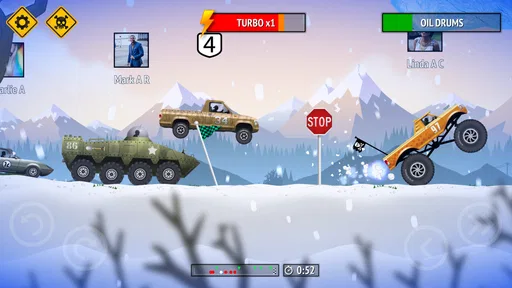
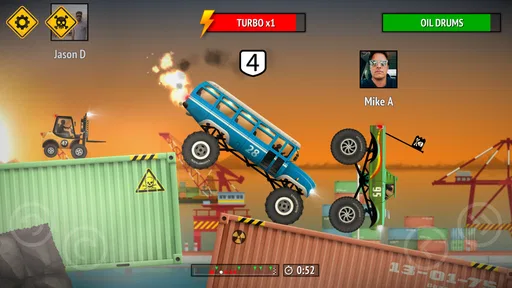
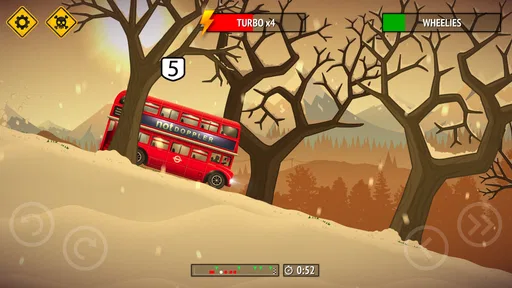
The tracks are designed around movement that feels more playful than realistic. Ramps, uneven surfaces, sudden changes in elevation, and close competition make every run feel slightly unstable. I am not simply steering along a flat road and waiting for the finish line. I am watching the vehicle’s position, preparing for the next landing, and trying to keep momentum after a jump. That gives the opening seconds a useful tension: going faster is attractive, but careless speed can leave me badly positioned.
I also like that the game makes failure readable. When a run goes wrong, I can usually connect the result to something I did: mistiming a jump, losing control after a landing, or allowing another racer to get ahead at the wrong moment. That clarity is important in a short-session game. If every defeat felt random, restarting would become irritating. Here, the action generally gives me a reason to believe that the next attempt might go better.
The control style is best approached with patience during the first few races. My instinct was to make constant corrections, but that often created more trouble than it solved. A lighter touch works better when the vehicle is airborne or coming down from a ramp. I found that concentrating on the next landing, rather than staring only at the racer ahead, made my runs more consistent. This is a small but useful adjustment that the basic store summary would not tell a new player.
That learning curve is also where the game separates itself from more conventional mobile racing games. Many familiar alternatives focus on road position, braking points, and clean turns. Renegade Racing places more emphasis on surviving a chaotic sequence of jumps and maintaining a useful rhythm through them. If you enjoy the feeling of correcting a bad landing and still recovering the race, this approach has character. If you prefer precise laps with predictable corners, it may feel too loose.
The feedback rhythm keeps each attempt understandable
The second part of the experience is the feedback rhythm: action, immediate result, and a clear reason to adjust. I accelerate into a section, commit to a jump, see whether the landing helps or hurts, and then make a quick decision about the next obstacle. That cycle is satisfying because the game rarely leaves me waiting for a result. The track answers my decision almost at once.
Good landings create a feeling of flow. I keep moving, stay near the competition, and feel that the race is still under control. Bad landings interrupt that flow and force me to recover. The contrast gives the game its energy. Even when I am not winning, I can identify the moment when the race changed direction, which makes the next attempt more purposeful.
The other racers contribute to this pressure. They are not just scenery placed beside me; their presence gives each section a practical question. Do I take a safer line and preserve control, or push harder because I need to make up ground? In a longer racing game, that decision might involve fuel, tire wear, or a detailed vehicle setup. Here it is compressed into a quick judgment made while the track is moving underneath me.
I found it helpful to stop treating every race as a demand for maximum speed. Sometimes the fastest-looking approach is not the best one because a clean landing preserves more of the run. This is one of the game’s more interesting trade-offs: aggressive play can produce a dramatic gain, but controlled play is often what keeps an attempt alive. Players who enjoy chasing perfect execution will probably get more from it than players who only want to hold one button and watch the vehicle move.
The feedback is not always perfectly gentle. When several things happen at once, a failed recovery can feel abrupt, especially if I am still learning how the vehicle reacts in the air. That friction is part of the challenge, but it can also be the point where casual players lose interest. I would not recommend judging the game after one rushed attempt. It makes more sense to play enough races to recognize the difference between a control mistake and a genuinely awkward moment on the track.
Why the reward matters after the finish
The reward stage is what turns a single race into a reason to continue. Finishing an attempt gives me more than a brief result screen; it creates a sense that the run has contributed to the next decision. I am not only asking whether I won. I am also thinking about what caused the result, what part of the track cost me time, and whether a different approach could turn the next race in my favor.
That is a modest kind of progression, but it suits the game’s pace. The best reward is often knowledge: learning when to commit, when to correct, and when not to overreact. A new player may initially focus on the vehicle in front, but experienced play becomes more about reading the shape of the course and planning the landing before the jump is complete. That change in attention is where the game becomes more engaging.
The game’s popularity gives some context for its accessibility. It has passed 50 million installs and holds a 4.5 average from around 110 thousand ratings. Those figures do not guarantee that every player will enjoy the handling, but they do match my impression that the basic loop is easy to approach. I did not need to be a dedicated racing fan to understand what the game wanted me to do.
Still, the free entry point comes with an important consideration. Optional purchases can make the broader progression feel less purely skill-based for players who prefer to unlock everything through play alone. I would approach the game with a simple rule: enjoy the racing first, and treat purchases as optional rather than necessary. If the pressure to spend becomes more noticeable than the satisfaction of improving, that is a good reason to step back.
Another useful habit is to use each race as a small experiment. Instead of restarting immediately after a poor opening, I sometimes continue to see whether I can recover. That teaches more than abandoning every imperfect run. Conversely, when I already understand exactly why the attempt failed and want to test one specific change, a quick restart is sensible. The ability to switch between learning and repeating keeps short sessions from feeling aimless.
This is also where the game works well for different kinds of players. Someone who wants a five-minute distraction can enjoy the immediate races without studying every system. Someone more competitive can focus on shaving away mistakes and improving consistency. The middle ground is less appealing for players who want a large garage, detailed tuning, or a long strategic campaign. Renegade Racing’s reward is primarily tied to action and repetition, not to the kind of ownership fantasy found in deeper car-management games.
The reset is the reason another session begins
The reset stage is central to the game’s design. After a race, I am rarely left with a long pause before the next decision. The attempt ends, I process what happened, and the possibility of another run appears quickly. That compact reset is why the game fits ordinary daily situations so well. I can stop after one race without feeling that I have abandoned a complicated activity, or continue because the last result exposed one mistake I want to fix.
A realistic example is a short break between tasks. I might open the game expecting one quick race, lose control near a jump, and immediately want another try because the failure was specific rather than confusing. The second attempt may be better simply because I now know where to stay calm. If I then win or make a cleaner run, the session has a natural ending point. The game does not require me to reserve an entire evening to feel that I accomplished something.
That reset can also work against it. Repeated short attempts may become repetitive if I do not enjoy refining the same kind of mistake. Players who need a strong narrative hook or a constantly changing objective may find the loop thin after the novelty fades. The game depends on the pleasure of doing the action better, not on a story that continually pushes me forward.
I would also avoid playing it when I am looking for a calm, low-attention experience. The races are brief, but the brevity does not make them relaxing. The track can demand quick corrections, and a casual glance away may be enough to spoil an attempt. For a quiet game before sleep, a puzzle or slower strategy title may be a better choice. For a short burst of concentration, this one makes more sense.
Compared with traditional arcade racers on mobile, it feels less concerned with polished lap racing and more interested in stunt-like momentum. Compared with realistic racers, it asks much less of my time and technical patience, but gives up detailed vehicle behavior and simulation depth. Compared with endless runners, it offers a clearer racing contest and more direct competition, while demanding more attention to landings and recovery. Those comparisons explain its place well: it is a compact, playful racer for people who enjoy repeated attempts with visible consequences.
Who should install it, and who should skip it
I would recommend it to players who like arcade racing, quick restarts, and the satisfaction of turning a messy attempt into a clean one. It is especially suitable for people who enjoy learning through repetition rather than reading long tutorials. Younger players can understand the basic premise quickly, although the Everyone 10+ rating is the appropriate guide for families deciding whether it matches their child.
I would be more cautious about recommending it to someone who wants realistic steering, licensed-car presentation, detailed setups, or a structured career that feels like a traditional motorsport game. It is also not the best match for anyone who dislikes in-app purchases on principle, since the free game includes optional items priced from $0.99 to $39.99 each. The purchase range is worth keeping in mind before handing the device to a child.
Device compatibility is fairly broad because the Android requirement begins at version 5.0. That makes it approachable for people using older supported phones, though the experience will still depend on how smoothly a particular device handles the action. I would close other demanding apps before playing on an older phone, not because the game is complicated to set up, but because fast racing is much less enjoyable when performance distracts from timing.
The developer, Not Doppler, has positioned this as a mobile version of an online hit that had already reached over 190 million plays. I see that background in the game’s immediate, repeatable structure: it feels designed to make one attempt understandable and the next attempt tempting. The important point is not the large play figure by itself, but the way the design translates a quick browser-style action idea into a format that works in short mobile sessions.
It is also worth knowing that the game has been available since November 11, 2019. That gives it a more established feel than a newly released experiment, while the current version, 1.3.5, indicates that the mobile edition has continued to receive version updates. I would still judge it by the core racing loop rather than expect it to behave like a brand-new release built around constant reinvention.
My verdict on the complete action loop
The loop is simple to describe but effective in practice: I take an action, receive immediate feedback, earn a reason to evaluate the attempt, reset quickly, and begin again because one small improvement feels within reach. That structure is the real strength of Renegade Racing. It does not need a long explanation to make a short session meaningful, and it gives skilled players room to improve without making newcomers wait to understand the basics.
Its limitations are just as clear. The handling may feel too chaotic for simulation fans, the repeated format can lose its pull for players who need constant novelty, and optional purchases mean the free experience should be approached with sensible expectations. None of those points ruins the game, but they define who will enjoy it most.
For me, the best sessions happen when I treat each race as a focused test rather than a demand to win every time. I watch the next landing, avoid unnecessary corrections, and use a failed run to change one decision instead of changing everything at once. That approach turns the reset into progress, even when the result screen is not a victory.
Renegade Racing is worth trying if you want fast arcade competition that rewards another attempt. I would recommend downloading it for short, energetic sessions and for players who enjoy mastering movement through repetition. I would skip it in favor of a more traditional racer if realistic driving, deep customization, or a slower strategic pace matters more to you than the immediate pleasure of jumping, recovering, and pressing the race button once again.
Verdict
Strengths of Renegade Racing
- Quick races make it easy to play during short breaks.
- Simple controls are accessible for players of different skill levels.
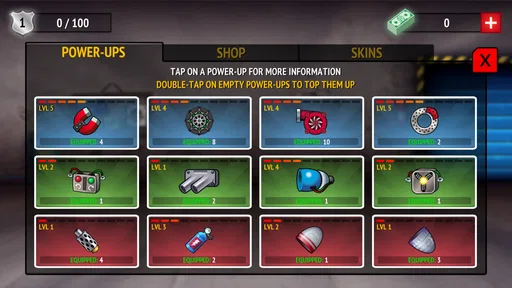
- Vehicle upgrades add a satisfying sense of progression.
- Bright cartoon visuals give the game a cheerful personality.
- Competitive events provide extra goals beyond standard races.
Limitations of Renegade Racing
- Frequent crashes and jumps can feel repetitive after extended play.
- Some upgrades may require considerable grinding to unlock.
- Races can become frustrating when opponents gain a sudden advantage.
- The game may consume noticeable battery during longer sessions.
- Progress can feel slow without spending in-app currency.
Other Releases by Not Doppler
View All


Similar Picks in This Category
View All
Hill Climb Racing
Fingersoft4.3

Dr. Driving
SUD Inc.4.2

Traffic Rider
skgames4.5

Asphalt 8 - Car Racing Game
Gameloft SE4.6

Race Master 3D: Car Racing
Beresnev Games4.6

Extreme Car Driving Simulator
AxesInMotion Racing4.3
Frequently Asked Questions
What is Renegade Racing and how does the gameplay work?
Renegade Racing is a fast-paced multiplayer racing game focused on short, action-packed matches. You choose a vehicle, race across obstacle-filled tracks, perform flips and stunts, collect boosts, and try to reach the finish line before your opponents. The controls are easy to understand, but mastering timing, landings, shortcuts, and vehicle upgrades takes practice. Races are designed to feel quick and competitive, making the game suitable for short play sessions.
Can Renegade Racing be played offline?
Renegade Racing is primarily designed around online competition and multiplayer racing, so a stable internet connection is generally required for the main experience. Offline availability may be limited, and some features, events, rewards, or progression systems might not work without connectivity. If you plan to play while traveling or with unreliable mobile data, check the current store description and test the game after installation, because offline support can change with updates.
Is Renegade Racing free to download and play?
Renegade Racing can generally be downloaded for free, but free access does not necessarily mean that every item is available without payment. The game may include optional in-app purchases for vehicles, upgrades, cosmetic content, currency, or other progression-related benefits. You can usually begin racing without spending money, although advancing faster or collecting certain content may require patience, repeated play, or optional purchases.
Does Renegade Racing include ads or in-app purchases?
Players should expect that Renegade Racing may contain advertising and optional in-app purchases, depending on the version and platform. Ads can sometimes appear between races or be offered in exchange for bonuses, while purchases may provide premium currency, upgrades, or cosmetic items. Before downloading, review the Google Play or App Store listing for the latest information, and use device purchase restrictions if children will be playing.
What devices are compatible with Renegade Racing, and does it require much storage?
Compatibility depends on your Android or iOS version, device hardware, and the requirements listed by the current store release. Because Renegade Racing features real-time racing, animated tracks, and online interaction, older phones may experience slower loading, reduced performance, or connection issues. The initial download may not represent the final storage requirement, since updates and additional game data can take extra space over time.
Play our best games!


